Context
The problem
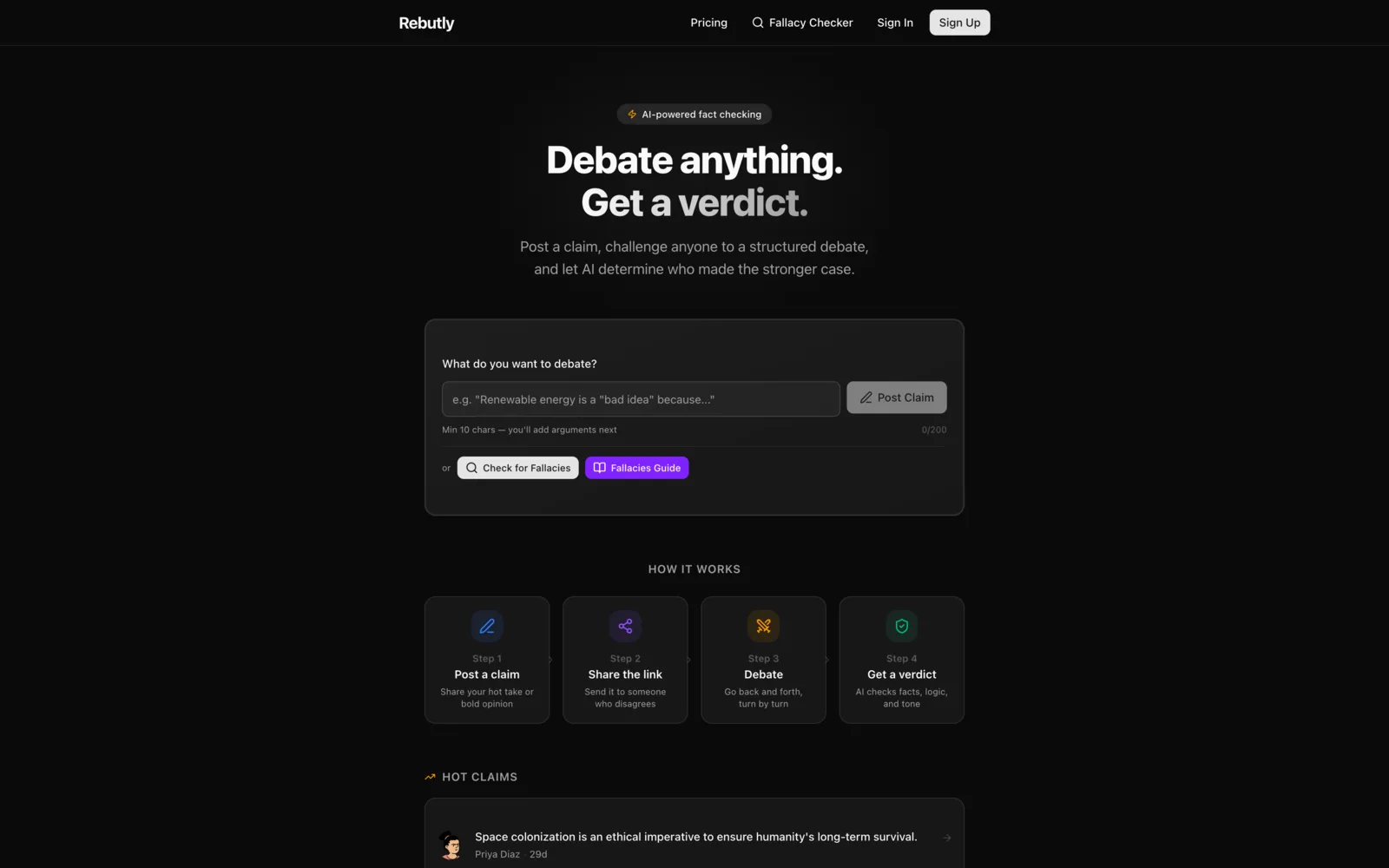
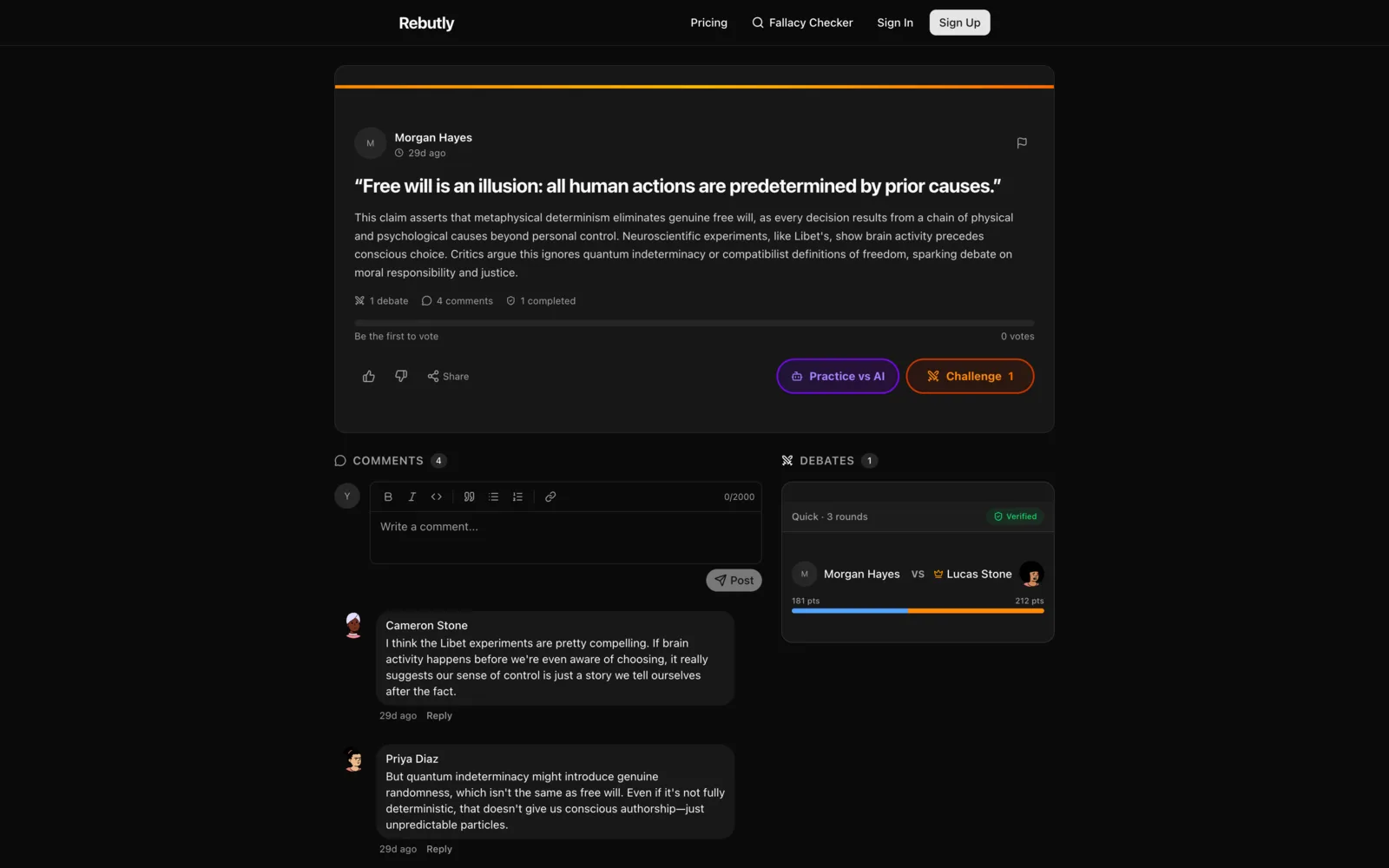
Online arguments have no referee. Rebutly scores debate claims and rebuttals with an LLM. But raw LLM output is unreliable as application data: free-text scores drift, formats break, and a UI can't be built on top of prose. The hard problem wasn't prompting; it was making model output trustworthy enough to render, rank, and persist, at a unit cost that survives a free tier.
Ownership
My role
Solo build: product, scoring pipeline, realtime layer, payments, and frontend.
Solution
Approach
Schema-first LLM pipeline
Every model call is contracted by a Zod schema: scores are clamped 0–100 with defaults, responses must parse as pure JSON, and a validation failure throws, which hands the call to a job queue that retries with exponential backoff. User content is embedded in XML-structured prompts with angle brackets sanitized to fullwidth Unicode, so debate text can't inject instructions. The application layer only ever sees typed, validated scoring objects, never raw model text.
Two models, three verification tiers
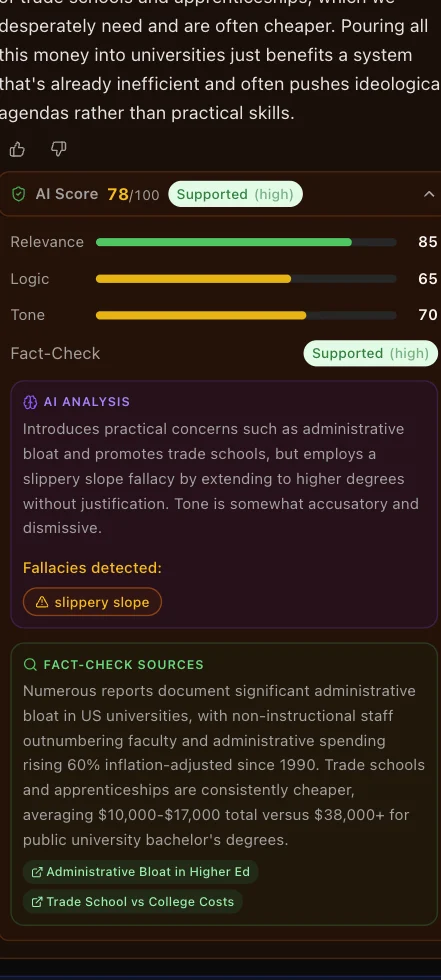
DeepSeek handles scoring and claim extraction (with thinking mode switched on for reasoning calls and off for generation, because they price differently), and Perplexity Sonar fact-checks extracted claims against live web sources, returning a verdict (supported / mixed / disputed / unverifiable), confidence, and citations. Debaters choose a verification tier: tone, logic, or full fact-check. A completed verification at a higher tier is reused instead of re-billed.
Scoring that changes incentives
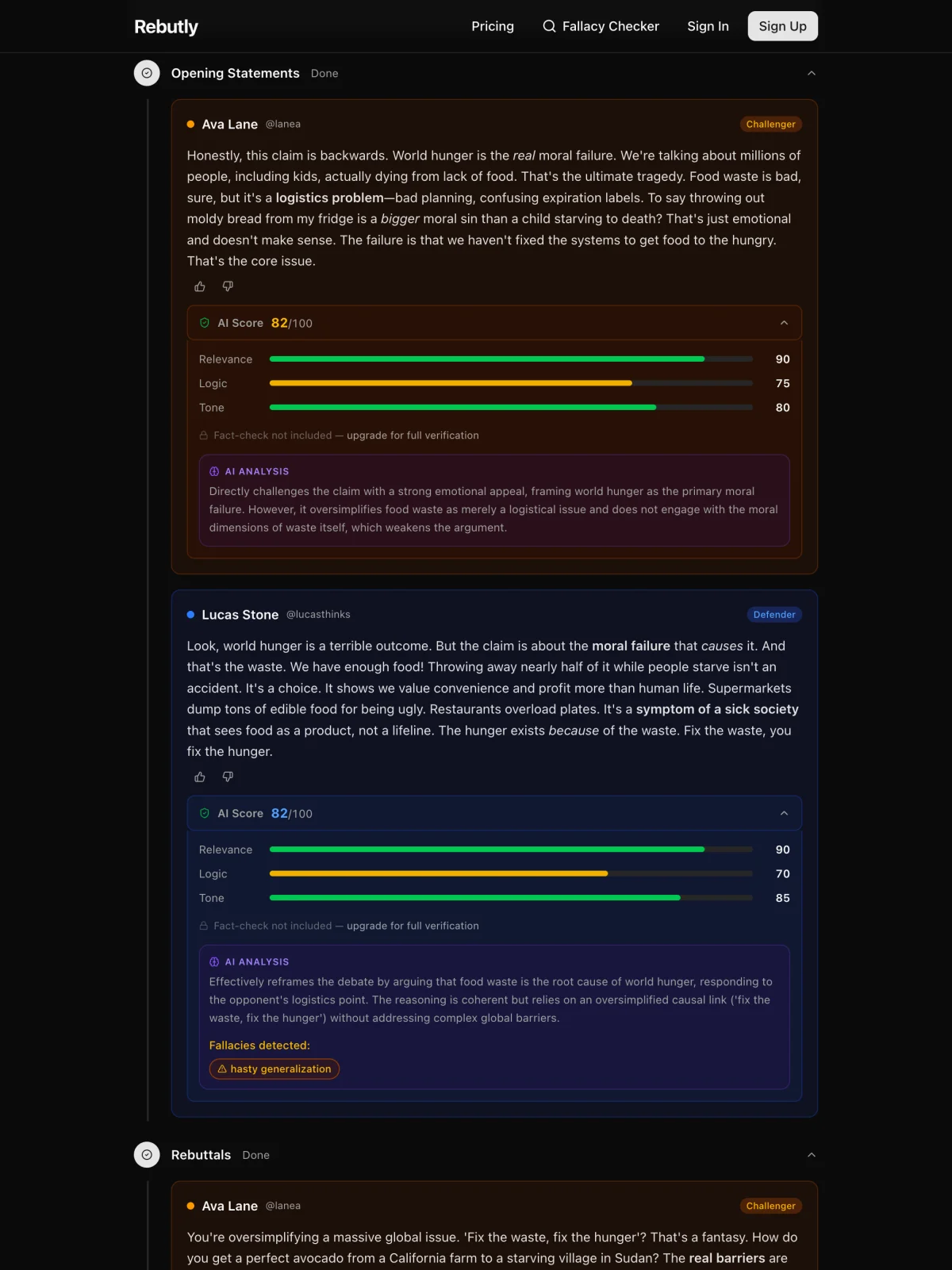
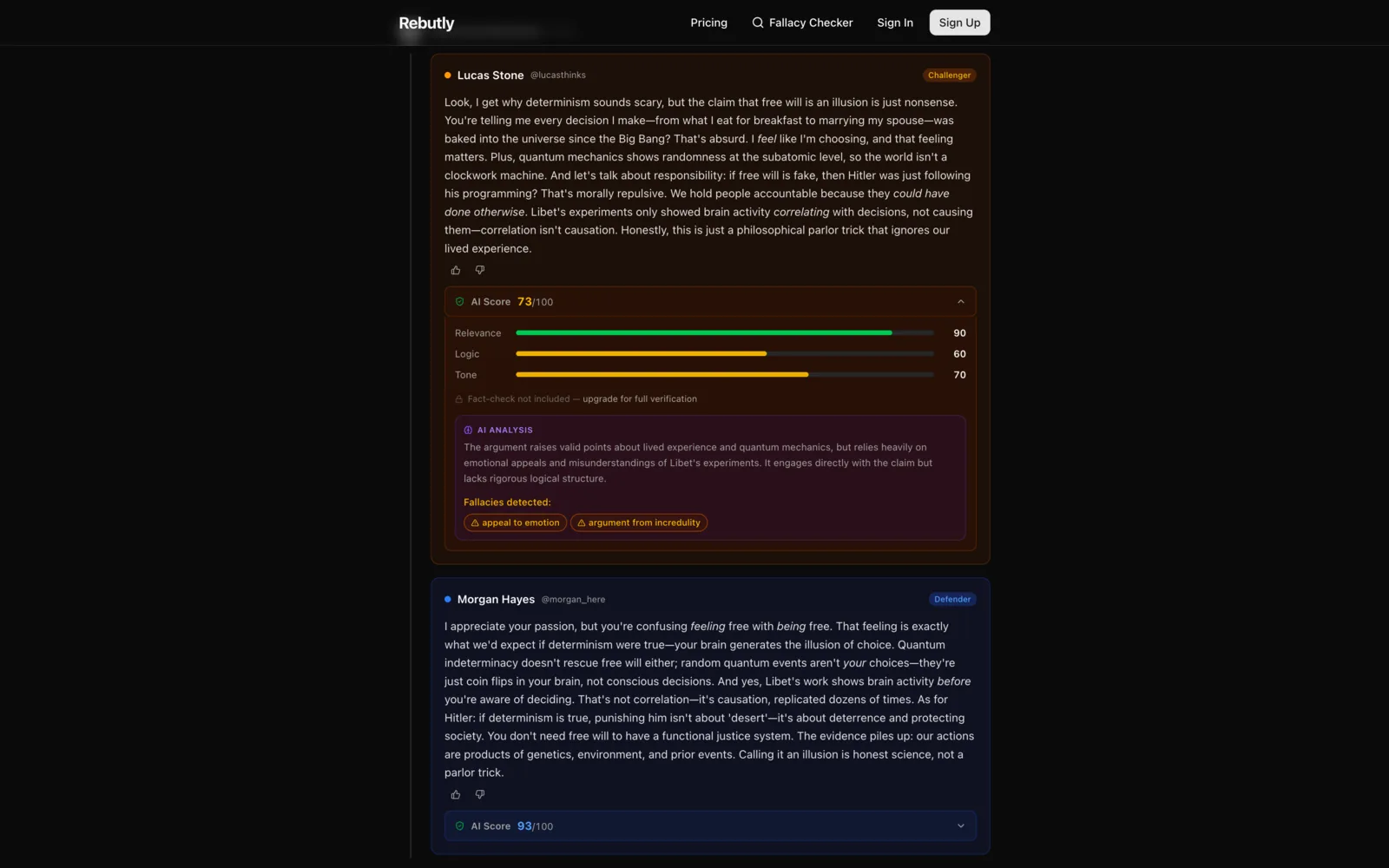
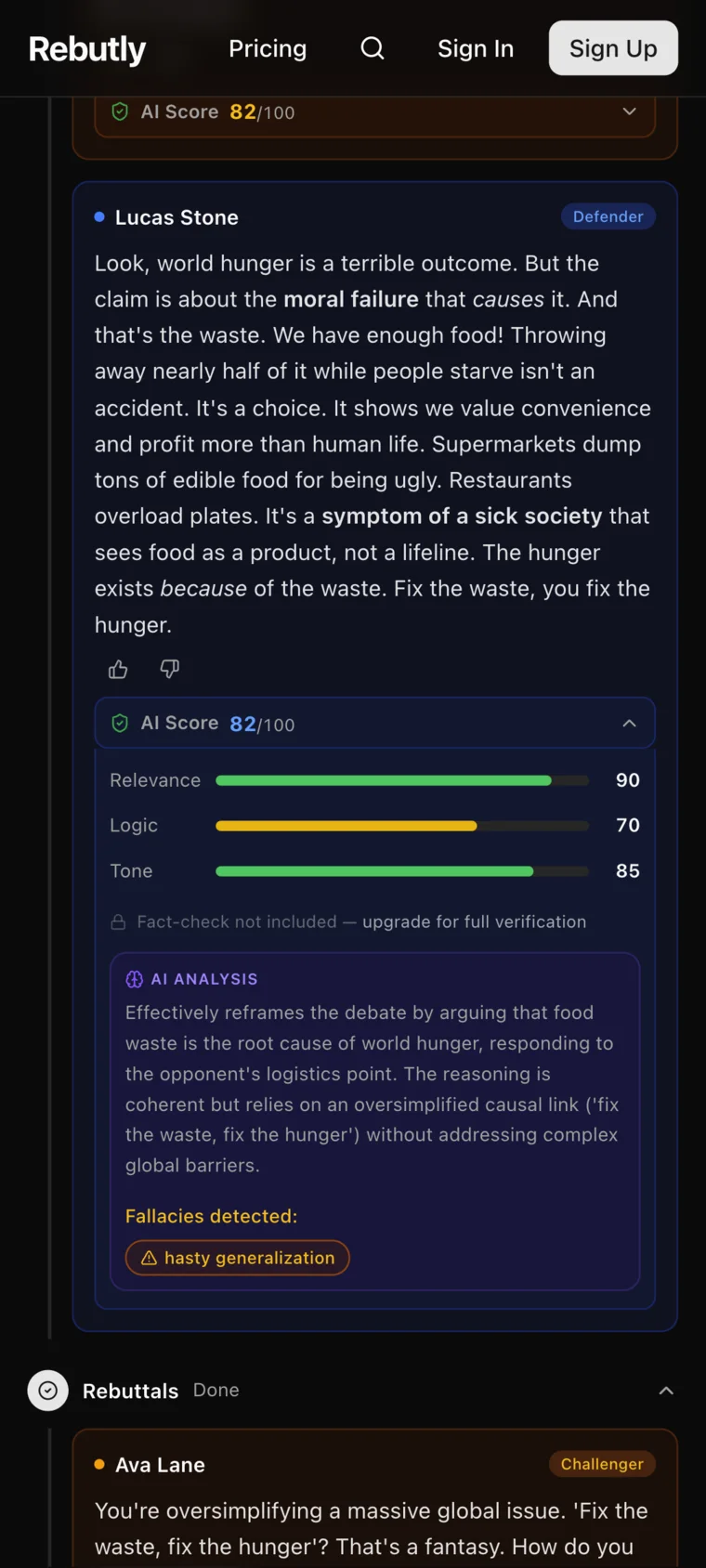
Each turn gets tone, logic, and relevance scores plus detected logical fallacies. Relevance explicitly penalizes statements that are factually true but dodge the opponent's argument. Ratings use a non-zero-sum ELO with split K-factors across tone, logic, and fact dimensions: both debaters can gain rating if both argue well, and both can lose it for a mud fight. Winning multiplies positive gains by 1.5×, which rewards quality first, victory second.
Cost engineering for a free tier
An entire debate is scored in one batched model call instead of one call per turn: every turn goes in a single request, with the token budget scaled to turn count. A daily budget circuit-breaker hard-stops AI spend at a configured cap, and every call lands in a usage ledger with per-provider token and cost breakdowns down to fractions of a cent. A full multi-model verification costs about a cent.
System
Architecture
A Turborepo monorepo: Next.js frontend, Hono API, shared Zod packages, PostgreSQL with Drizzle, and a PostgreSQL-backed job queue for verification work. Self-hosted LiveKit powers live audio debates, with data channels pushing score updates to spectators in realtime.
- Zod schemas as the single contract between model and application, with validation failure triggering a queued retry
- Batched scoring: all debate turns evaluated in one model call
- Per-call AI usage ledger: provider, model, cached/reasoning/citation tokens, cost to 6 decimals
- Daily AI budget circuit-breaker with in-memory caching
- Live audio debates over self-hosted LiveKit with realtime score pushes
- Paddle subscriptions with per-tier usage caps
Results
Outcomes
100%
of rendered scores schema-validated
1 call
scores an entire debate, every turn batched
~1¢
for a full two-model fact-checked verification
0
free-text model output reaching the UI
- Live at rebutly.com.
- The schema-first pattern generalizes to any LLM-backed product. It's the same discipline I bring to client AI work.
- Cost ledger + circuit breaker means the free tier can't bankrupt the platform.


Contact
Get in touch.
If you're building something and want a hand, write to me. Same if you just want a second opinion on an architecture decision.
Prefer to talk? Grab 15 minutes in my calendar.